
In 2020, Steve gave a public lecture about the group’s research at the New York Academy of Science Game Changers symposium. If you’re interested in an accessible overview of the work we do, see the video below.
For more details, read more on our major areas of interest below!
Applications of Mechanically Interlocked Molecules
Our general research focus is on the synthesis and applications of mechanically interlocked molecules such as rotaxanes (an example of which is shown in the centre on the right) and catenanes. These challenging molecules have been shown to have potential applications in catalysis, drug delivery, electronic materials and sensing. We also investigate new synthetic methods and the underlying mechanism of organic reactions in order to develop molecular machines which carry out synthetic tasks to produce novel materials that are extremely hard to access in other ways – a trick we know can be used to great effect as many such devices are found in living cells!
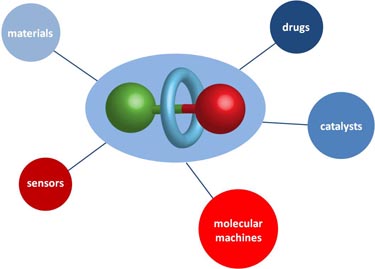
For an introduction to the field see Steve and Ed’s Chem. Commun. Feature on the chemical consequences of the mechanical bond – click here
Size Matters: Active template synthesis of functional interlocked molecules
The active template approach to mechanically interlocked molecules is a versatile and powerful method for synthesising catenanes and rotaxanes which are impossible to form using other methods and the first approach capable of operating with substochiometric quantities of template.
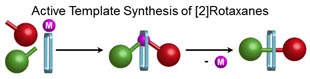
We recently pioneered the use of “small” macrocycles in active template reactions in order to allow the synthesis of “small” rotaxanes. Initial studies on the copper mediated “click” triazole active template reaction revealed that small macrocycles actually increase the yield of the desired rotaxane, a somewhat surprising result considering the level of steric congestion in the interlocked product. We demonstrated the utility of this approach through the synthesis of a number of functionalised rotaxane products in high yield. We are now applying this methodology to the synthesis of complex functional rotaxanes including insulated molecular wires for molecular electronic applications and small molecule fluorescent sensors.

For more information see: Angew. Chem., Int. Ed. 2011, 50, 4151.
Mechanical Bonding to Stabilise Reactive Intermediates – a Stable Cu(I) Organometallic
We have recently extended our small macrocycle AT-CuAAC methodology to the synthesis of a sterically protected Cu(I)-organometallic which survives column chromatography and aqueous work up. It can even be synthesised under aqueous conditions! This is only the second example of an isolated Cu-triazolide and the first to display this level of stability. This further demonstrates the potential of the mechanical bond to stabilise reactive species and we are currently investigating the properties of these extremely unusual copper complexes.
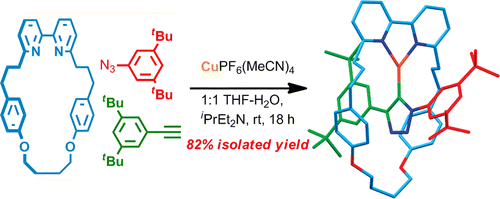
For more information see: J. Am. Chem. Soc. 2013, 135, 13318.
Mechanically Chiral Rotaxanes
Interlocked structures such as catenanes, rotaxanes and knots can display molecular asymmetry as a direct result of the mechanical bond. However, relatively few such molecules have been isolated enantiopure because the methods needed to produce them (usually chiral stationary phase HPLC) are not suited to large scale investigations. We recently demonstrate the first scalable synthesis of mechanically planar chiral rotaxanes in high enantiopurity, using a “chiral auxiliary” type approach: the AT-CuAAC reaction using a covalently chiral stopper was used to synthesise and separate mechanical diastereomers that differ only in the orientation of the macrocycle. Subsequent cleavage of the auxiliary from the separated diastereoisomers led to mechanically chiral rotaxanes in >99% ee. We are now working to extend this approach to other active template reactions and investigate the properties of this newly accesible form of molecular asymmetry.
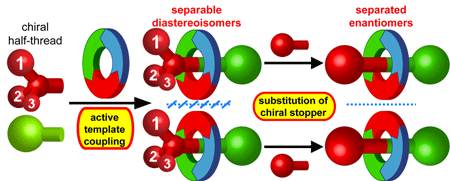
For more information see: J. Am. Chem. Soc., 2014, 136, 4817.
 golduplab.org